Any integer can be optimally constructed with a straightedge and compass in $O(\log |x|)$ time. This is a basic result, but I could not find it documented elsewhere.
Preliminaries
Define a step as the following: given two already-constructed points $m$ and $n$ on a line, construct the point $2n - m$ by intersecting the line through $m$ and $n$ with the circle centred at $n$ passing through $m$. This results in two points: $m$ (by definition), and $n + (n - m) = 2n - m$.
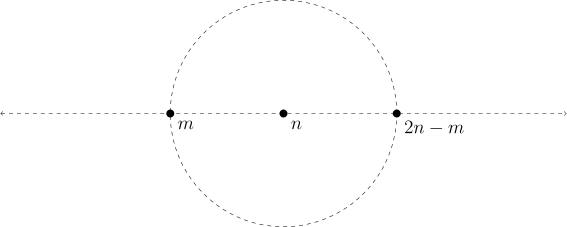
Assume the initial point set is $P_0 = \{0, 1\}$.
Theorem 1 (Upper bound)
Every integer $x$ can be constructed in at most $\lfloor \log_2 |x| \rfloor + 2$ steps.
Proof. The cases $x \in \{0, 1\}$ are trivial. For $|x| \geq 1$ the proof proceeds in two parts.
Positive case ($x \geq 1$)
Define a sequence $(S_k)$ by $S_0 = x$ and, for $k \geq 0$:
The sequence terminates when $S_k = 1$. Since $S_{k+1} \leq \lceil S_k / 2 \rceil < S_k$ for all $S_k > 1$, the sequence is strictly decreasing in the positive integers and terminates at some index $K$ with $K \leq \lfloor \log_2 x \rfloor + 1$.
Reversing the sequence yields valid steps. Reading from $S_K = 1$ back to $S_0 = x$:
- Even case: $S_k = 2\,S_{k+1} - 0$. Apply the operation with $n = S_{k+1}$, $m = 0$.
- Odd case: $S_k = 2\,S_{k+1} - 1$. Apply the operation with $n = S_{k+1}$, $m = 1$.
In both cases $n = S_{k+1}$ has already been constructed (by induction from $S_K = 1$) and $m \in {0, 1} \subseteq P_0$.
Negative case ($x \leq -1$)
Observe that for any constructed point $p$, the point $-p = 2 \cdot 0 - p$ can be obtained in one step by reflecting $p$ through the origin. Therefore, first construct $|x|$ using the positive case in at most $\lfloor \log_2 |x| \rfloor + 1$ steps, then apply a single reflection to obtain $x = -|x|$. The total is at most $\lfloor \log_2 |x| \rfloor + 2$ steps. $\quad\square$
Theorem 2 (Lower bound)
No construction from ${0, 1}$ can reach an integer $x$ in fewer than $\log_3 |x|$ steps. In particular, the number of steps is $\Omega(\log |x|)$.
Proof. After $k$ construction steps, let $R_k = \max{|p| : p \in P_k}$ be the largest absolute value in the constructed set. Initially $R_0 = 1$. For any $m, n \in P_k$:
so $R_{k+1} \leq 3\,R_k$ and by induction $R_k \leq 3^k$. To reach $x$ we require $3^k \geq |x|$, hence $k \geq \log_3 |x|$.
Since $\log_3 |x| = \log_2 |x| / \log_2 3$ and $\log_2 3$ is a constant, this is $\Omega(\log |x|)$. $\quad\square$
Corollary
The construction complexity of an integer $x$ from ${0, 1}$ is $O(\log |x|)$.
Theorem 1 gives an upper bound of $\lfloor \log_2 |x| \rfloor + 2$ and Theorem 2 gives a lower bound of $\Omega(\log |x|)$. The additive constants are absorbed by asymptotic notation, so the complexity is $O(\log |x|)$.